Clearance CLR-2495 · AIR102
AIRIAT
Air CargoClearance sheet
IATA Reports 5.6% Air Cargo Demand Growth in January 2026
IATA puts global air cargo demand growth at 5.6% year-on-year for January 2026, drawing on cargo tonne-kilometre data submitted by commercial airlines operating worldwide under IATA designator codes.
Read-back
- Air cargo demand grew 5.6% year-on-year in January 2026, according to IATA.
- The reading compares January 2026 freight volumes against the same month in 2025.
- IATA tracks global freight output in cargo tonne-kilometres, weighting tonnage by distance flown.
- IATA publishes the demand figure alongside available cargo tonne-kilometres and a cargo load factor.
- The February 2026 monthly release will provide the first cross-check on January's pace.
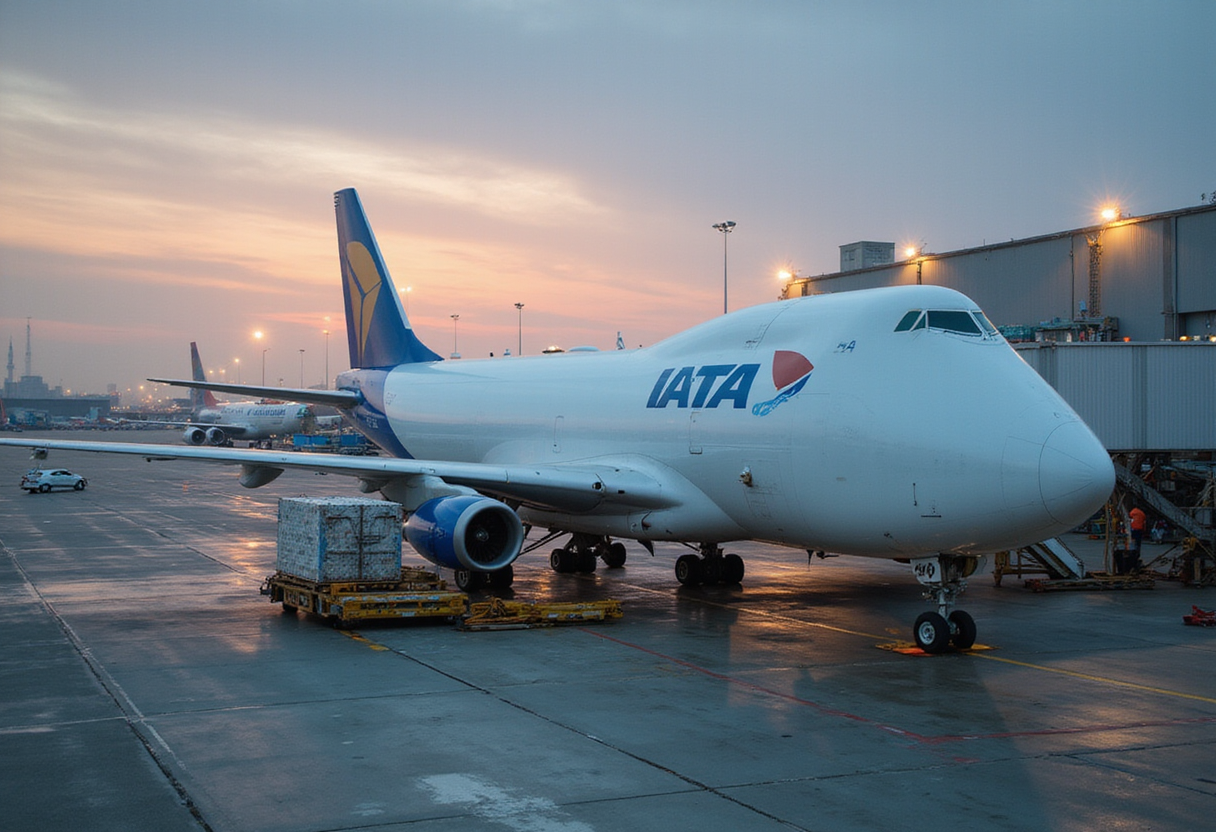
Global air cargo demand grew 5.6% year-on-year in January 2026, according to IATA. The reading, drawn from the trade association's monthly Air Cargo Market Analysis, measures freight volumes carried by commercial airlines and rolls them into a single global figure expressed in cargo tonne-kilometres (CTK).
What does the 5.6% measure?
CTK weights each shipment's tonnage by the distance flown, then sums the result across the global network. IATA strips out currency fluctuations and adjusts for differences in the working-day calendar, so January 2026 versus January 2025 reflects an underlying volume shift rather than arithmetic noise.
A 5.6% reading places freight flows 5.6 percentage points above the prior-year benchmark. The metric covers both belly-cargo moved in passenger jet holds and tonnage flown by dedicated freighter aircraft.
IATA draws the underlying data from carriers submitting figures under its Carrier Coding Service, which standardises how airlines report CTK. The operators carrying IATA designator codes move the bulk of the world's commercial air freight.
Why does IATA track it monthly?
Air cargo runs as one of the earliest available signals of global merchandise trade. High-value, time-sensitive goods — semiconductors, pharmaceuticals, perishables, automotive parts, plus the steady rise of cross-border e-commerce parcels — move primarily by air. CTK swings tend to lead container shipping volumes and official export statistics by weeks or months.
IATA publishes the demand reading alongside two companion metrics: available cargo tonne-kilometres (ACTK) for capacity, and the cargo load factor, the ratio between the two. Together they tell whether demand is rising into a tight capacity environment, a loose one, or somewhere in between.
A 5.6% demand print reads very differently against flat ACTK than against double-digit capacity growth. A tight market supports yields; a loose one weighs on operator unit revenues.
What the January number doesn't tell us
A single consolidated percentage leaves substantial detail on the table. IATA's full release typically disaggregates demand by region — Asia-Pacific, Europe, North America, Latin America, Middle East, Africa — and between international and domestic services.
The release also separates performance across integrator networks, combination carriers and pure freighters. The 5.6% compresses all of that into one figure; regional splits, segment mix and capacity trends live in the underlying tables released alongside it.
For airlines and freight forwarders running scheduled lift, the reading offers directional comfort rather than a stand-alone verdict. Utilisation and yield data for January 2026 will only clarify once operators file their full monthly traffic returns.
The January reading covers demand against a prior-year base that itself ran through swings tied to e-commerce growth, supply-chain re-routing and shifting consumer-goods trade patterns. Stripping those out matters: a 5.6% gain against a strong January 2025 looks different from the same percentage against a depressed one.
The next monthly release, covering February 2026, brings the freight market's first cross-check. Whether January's pace carried forward — alongside Lunar New Year shipping patterns that typically reshuffle east-Asia outbound tonnage — will tell operators whether 2026 opened with real momentum or a calendar-driven blip.
via Google News: Air cargo (Source)
More from Nathan Brooks
Show full bio
Correspondent covering technology and product news in Commercial aviation industry coverage at Flightdeck Report.
445 articles
Same bay
- FDR191IATA Air Cargo Market Analysis for July 2026 Arrives Amid Capacity Questions · October 14, 2026
- FDR191Air Cargo Demand Climbed 11.2% in February, IATA Says · October 14, 2026
- FDR351IATA Publishes February 2026 Air Cargo Market Analysis · October 14, 2026
- FDR449IATA releases August 2026 air cargo market analysis · October 10, 2026
- FDR966IATA reports strong air cargo demand in August · October 10, 2026