Clearance CLR-3257 · AIR492
AIRDUF
Airspace & RegulationClearance sheet
Duffy and Airlines Press Congress for $30 Billion ATC Overhaul
Duffy, airlines and unions want $30 billion more for towers, telecom and airports, weeks after a $12.5 billion start and days after an East Coast telecom failure.
Read-back
- Duffy, airlines and unions requested $30 billion on September 28, 2026, on top of $12.5 billion approved in June 2025.
- About $10 billion is earmarked for tower replacement and $10 billion for telecom and ATC technology, including cybersecurity.
- The GAO says the telecom upgrade cost has risen $4.75 billion to $5.91 billion; copper wiring is due for full replacement by September 2027.
- The request follows a telecom failure last week that disrupted thousands of East Coast flights.
- Roughly $7.2 billion would expand a predictive-analytics flight-management system the FAA began using last week.
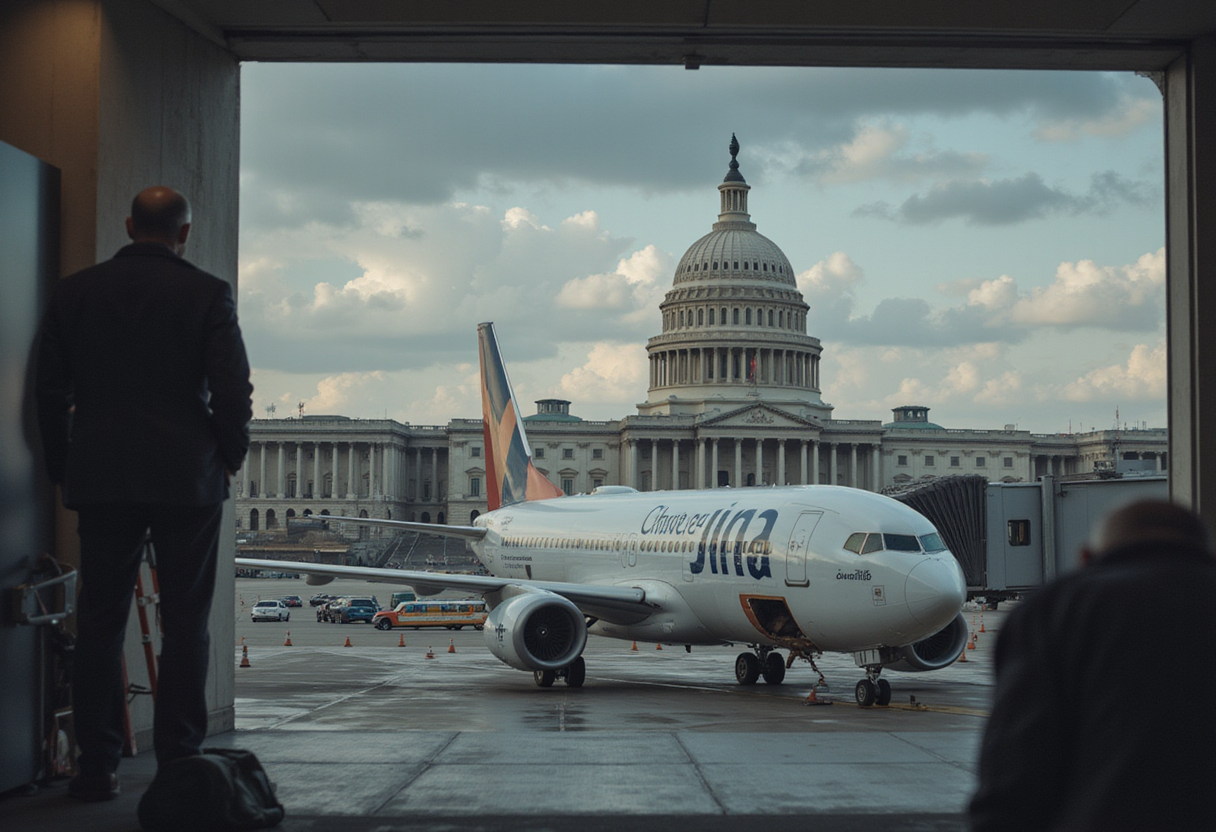
US Transportation Secretary Sean Duffy, major airlines and aviation unions asked Congress on Monday for another $30 billion to replace air traffic control towers, modernize telecommunications and expand mid-sized airports. The request comes just fifteen months after lawmakers approved $12.5 billion over five years for the same system, and one week after a telecommunications failure paralyzed East Coast traffic for hours.
The arithmetic is blunt. Congress committed $12.5 billion in June 2025. The administration now wants roughly two and a half times that amount on top. Duffy made his case at Ronald Reagan Washington National Airport, the site of a January 2025 mid-air collision that killed 67 people. "We want to finish the job," he said.
Where would the $30 billion go?
The funding breaks into three broad tranches, according to the Transportation Department:
- About $10 billion to replace aging air traffic control towers.
- Another $10 billion for telecommunications and other air traffic control technology, including cybersecurity upgrades.
- Roughly $7.2 billion to expand a new software-based system the Federal Aviation Administration began using last week, which applies predictive analytics to flight management.
The remainder targets airport infrastructure. That airport money is aimed at medium-sized facilities, financing new terminals and capacity expansion. The Transportation Department argues that upgrading those airports would relieve congestion at the major hubs that currently absorb most of the traffic.
Why now?
A major telecommunications failure last week disrupted thousands of flights along the East Coast for hours, and it has given the request fresh political momentum. The incident exposed the fragility of infrastructure that, in places, still runs on copper.
The cost of fixing it is climbing. The US Government Accountability Office reported earlier this month that the price tag for telecom upgrades has jumped by $4.75 billion, to $5.91 billion. That is a near-doubling of the original estimate in a single revision. FAA Administrator Bryan Bedford said outdated copper wiring should be completely replaced by September 2027.
Who is carrying the bill?
Republican Senator Eric Schmitt introduced the proposal containing the $30 billion sought by the Trump administration. Duffy has steadily raised his ask since the June 2025 appropriation, which funded system upgrades and accelerated controller hiring after years of complaints about congestion, delays and a string of technology failures.
Duffy conceded that earlier reform efforts had not succeeded. The admission is notable, and it frames the current request: $12.5 billion bought the first phase, and the administration believes the job remains roughly $30 billion short of finished. Congress, which took months to approve the first tranche, now decides whether the second one moves quickly or stalls.
For airlines, the stakes are operational. Every hour of East Coast paralysis strands aircraft and crews across the network, and congestion at saturated hubs constrains the schedules that carriers can profitably fly. The sector's willingness to lobby alongside its unions suggests the industry views the $30 billion as capacity insurance rather than bureaucratic appetite. Whether Schmitt's proposal survives the appropriations process, and at what figure, will shape US airspace capacity well past 2027.
via storage.googleapis.com (Original)
More from Grace Kim
Show full bio
News editor covering companies, deals and strategy in Commercial aviation industry coverage at Flightdeck Report.
405 articles
Same bay
- FDR856Duffy Puts $30 Billion Price Tag on Air Traffic Control Overhaul · September 28, 2026
- FDR852Duffy Backs $30 Billion Air Traffic Control Modernization Push · October 12, 2026
- FDR449Transportation secretary puts $30 billion price tag on ATC modernization · October 10, 2026
- FDR763Duffy Seeks $30 Billion More to Rebuild US Air Traffic Control · September 30, 2026
- FDR915Transportation secretary asks Congress for $30 billion ATC overhaul · September 28, 2026