Clearance CLR-8302 · AIR847
AIRAIR
Aircraft & EnginesClearance sheet
Airbus says A350 rate increase beyond 12 a month is 'inevitable'
Airbus commercial aircraft chief Lars Wagner calls a rate increase beyond the A350 line's 12-13 per month design ceiling 'inevitable,' pending board approval.
Read-back
- Lars Wagner said on October 14, 2026 that a decision on higher A350 output is 'inevitable' and would need board approval.
- The existing A350 line was designed for 12-13 aircraft per month; going higher requires a new assembly line.
- Airbus reaffirmed a target of 12 A350s per month in 2028 in its July 2026 results.
- In May 2026 some A350 customers were warned of delays due to fuselage shortages, partly at the former Spirit AeroSystems plant in North Carolina.
- A350-2000 and A220-500 stretch studies exist internally; neither aircraft is formally launched.
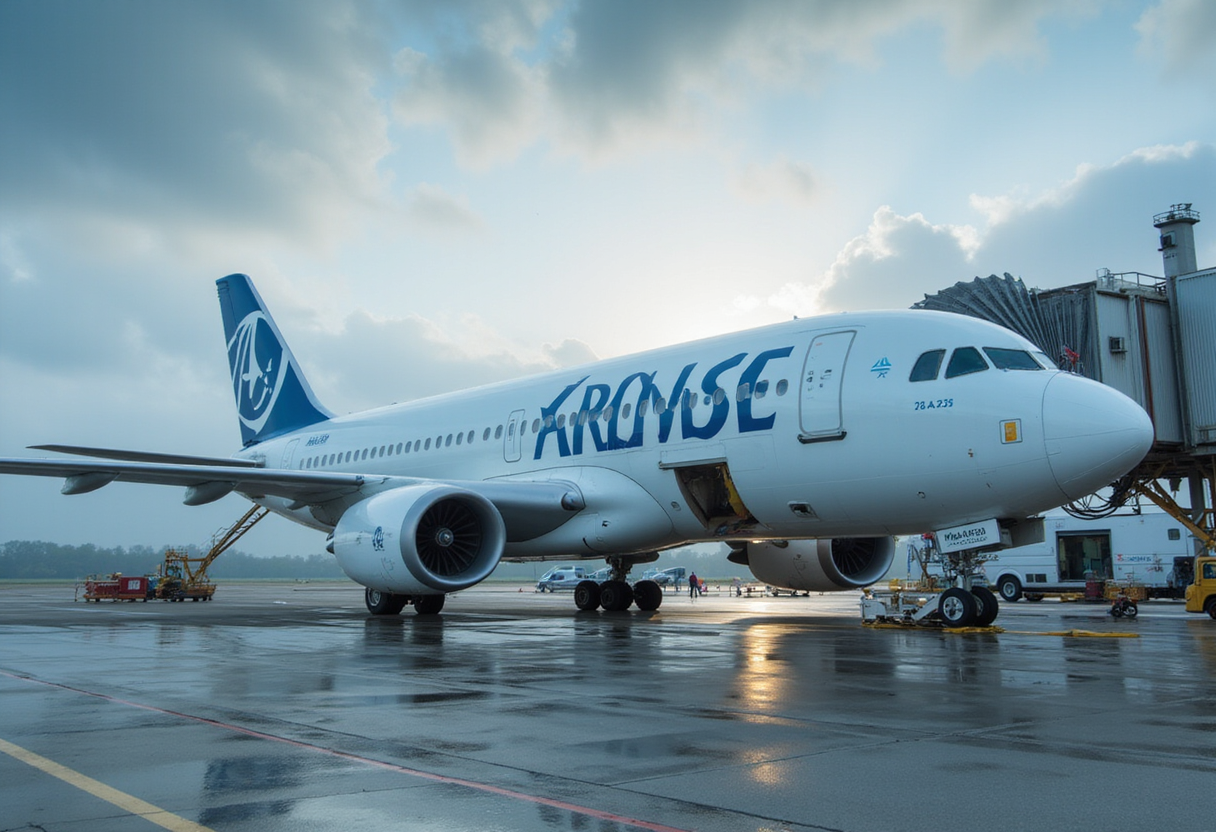
Airbus has designed its A350 assembly system for a ceiling of 12 to 13 aircraft per month, and commercial aircraft chief Lars Wagner now says going beyond that rate is "inevitable" — a decision he expects the company to take soon.
Speaking at a briefing in Toulouse on October 14, 2026, Wagner said the investment would need board approval, Reuters reported. His framing matters because the existing A350 final assembly line in Toulouse cannot simply be pushed harder; anything above roughly a dozen jets a month requires another line and additional manufacturing capacity.
What does this change for airlines waiting on A350s?
In the near term, nothing. The confirmed target remains 12 A350s per month in 2028, a figure Airbus reaffirmed in its July 2026 financial results. The expansion now under discussion would push output above that level, but no rate, date or investment amount has been approved.
The gap between ambition and delivery is the operative constraint. In May 2026, Airbus warned some A350 customers of later deliveries amid shortages of fuselage sections. The disruption traced in part to the former Spirit AeroSystems plant in North Carolina, which Airbus absorbed as part of the supplier's breakup.
So the mechanism works like this: Airbus sold long-haul capacity into its backlog faster than its supply chain can feed the assembly line. A second line adds final-assembly capacity, but it does not by itself fix fuselage section shortages upstream. Wagner's board case will hinge on whether component flow can be stabilized first.
The smaller aircraft carry the same lesson. In its first-quarter results, Airbus said Pratt & Whitney engine deliveries are capping increases in A320-family production through both 2026 and 2027. Engines, not assembly slots, set the effective output ceiling on that program.
Larger variants under study, not launched
Airbus is also studying stretched versions of both its clean-sheet programs: an A350-2000 and an A220-500, the designations internal rather than launched. Wagner said there is demand for both aircraft.
Decisions on whether to actually build them are expected early in the company's next five-year planning period. Neither has been formally launched, and no engine selection, specification or entry-into-service date exists in the public record.
For network planners at long-haul operators, the A350-2000 question is a capacity question: a larger A350 would add seats on trunk routes without adding slots or flight cycles. But an unlaunched study does not enter a fleet plan — it enters a watch list.
The verification standard
n Treat Wagner's statements as forward guidance, not backlog data. What is certified and flying today is the A350 at rates below the 2028 target of 12 per month, with some customers still absorbing May 2026 delivery slippage. What is promised is a rate above 12, a possible second assembly line, and two unbuilt variants.
The board approval Wagner references is the gate that converts the promise into a program. Until then, the measurable facts are these: a 12-per-month target for 2028, fuselage shortages dating to May 2026, a Pratt & Whitney engine constraint on the A320 family through 2027, and two internal design studies awaiting a decision early in the next planning cycle.
Airbus has committed to deciding soon. When that decision lands, it will show whether the company believes its supply chain can support the demand its order book has already captured.
via reuters.com (Original)
More from Sophie Lindqvist
Show full bio
Senior reporter covering people, launches and day-to-day practice in Commercial aviation industry coverage at Flightdeck Report.
479 articles
Same bay
- FDR283Industry order backlog tops 17,000 aircraft for first time · September 30, 2026
- FDR794Airbus counts 14 customers for A350F as freighter takes flight · September 30, 2026
- FDR324Airbus A350F Completes First Flight · September 29, 2026
- FDR738A350F First Flight Opens Nine-Month Certification Campaign · September 30, 2026
- FDR591Boeing Tells Airline Fleet Planners to Lengthen Their Horizon · October 10, 2026